
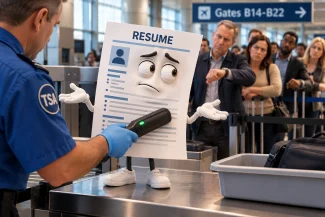
 A resume can look terrific on screen and still cause problems once it reaches an employer’s hiring system. I’ve seen plenty of documents with attractive layouts, carefully chosen wording, and impressive career histories that make important qualifications unnecessarily difficult to find.
Much of the advice job seekers receive focuses on keywords. Those matter, of course, but AI resume parsing involves more than checking whether certain words appear on a page. Depending on the software an employer uses, information may be extracted, classified, standardized, and compared with requirements in a job posting. How clearly you present your experience can influence each of those steps.
This doesn’t mean every employer uses the same technology or that software makes every hiring decision. It means the resume has another reader to consider, one that processes information differently from a recruiter.
What Happens to Your Resume After You Apply?
Imagine a recruiter looking at a resume that says the candidate led a companywide infrastructure modernization project. Someone familiar with IT can probably infer quite a bit from that description, particularly after reviewing the surrounding work history.
For AI resume parsing, a computer system needs the information in a form it can recognize and store. It may try to identify the employer, job title, employment dates, technologies, credentials, and relevant skills, then place those details into searchable fields.
That’s the basic purpose of AI resume parsing. A candidate might have worked as a Systems Administrator from 2020 to 2024 and used Azure, Active Directory, and Microsoft 365. Ideally, the system captures each detail accurately and associates it with the right position.
But resumes aren’t standardized forms. Candidates use different layouts, put dates in different places, and sometimes combine several kinds of information into one complicated sentence. Tables, graphics, unusual headings, and inconsistent formatting can make extraction less reliable in some systems.
AI resume parsing technology can handle many documents that older parsers struggled with. I still wouldn’t make a resume unnecessarily complicated just to give it a distinctive appearance. A conventional layout with clear headings and consistent dates is usually the safer choice.
Why Names, Skills, and Certifications Need to Be Recognizable
One of the processes behind AI resume parsing is called entity extraction. An entity is an identifiable piece of information: an employer, college, certification, software product, professional credential, or similar item.
Take this line from an IT resume: “Managed Azure cloud migration and integration with Microsoft 365.”
A system might identify Azure, Microsoft 365, and cloud migration as separate concepts. Those distinctions are useful because a recruiter may search for one of them without searching for the others.
The principle applies to nearly every industry. A nurse might mention electronic health records, HIPAA, and Joint Commission standards. A manufacturing leader may have worked with SAP, ISO 9001, and Lean Six Sigma. Someone in marketing operations could have experience with Salesforce, HubSpot, and Marketo.
For AI resume parsing, recognizable names help explain the person’s background. The trouble starts when valuable credentials get buried in a long paragraph, or when the same technology is described inconsistently throughout the resume.
I’ve reviewed documents where a certification that could have helped establish a candidate’s qualifications was almost invisible. It was technically there, but a busy recruiter would have had to look closely to find it. That is worth fixing regardless of how sophisticated the employer’s software happens to be.
When Different Job Titles Describe the Same Work
Employers have never been particularly consistent about job titles. One organization needs an IT Support Specialist, another advertises for a Desktop Support Analyst, and a third hires an End User Computing Technician. Read the job descriptions and you may discover substantial overlap.
Some hiring platforms attempt to account for that through normalization, which means connecting different expressions to a common concept. In AI resume parsing, normalization may apply to titles, skills, credentials, and technologies.
Suppose your official title was Client Technology Associate, but you spent most of your day troubleshooting workstations, deploying computers, and assisting employees with technical problems. A recruiter searching for desktop support experience would probably consider that background relevant.
For AI resume parsing, the resume needs to make the connection apparent. Your original job title should remain accurate, while the description beneath it should explain the work in familiar industry terms. There’s no advantage in inventing a grander title or replacing “desktop support” with language nobody uses in actual job postings.
The value of normalizing terminology is that people with comparable experience can be considered even when their employers called the work something different. It isn’t a reason to exaggerate qualifications or pretend unrelated positions are interchangeable.
How Software Connects Related Skills
Another term that comes up in AI resume parsing is taxonomy. In this context, it means a system for grouping related skills, occupations, and credentials.
Consider someone who has worked with Docker, Kubernetes, Terraform, and Jenkins. Those tools serve different purposes, but together they may indicate experience with DevOps, cloud engineering, or infrastructure automation. A hiring platform may use relationships like these to help classify a candidate’s expertise.
The same idea applies outside technology. Familiarity with cGMP, FDA regulations, and ISO 13485 could support a background in regulated manufacturing, depending on what the person actually did. Experience with Salesforce and Marketo may be relevant to marketing operations or revenue technology.
AI resume parsing is one reason I pay attention to how a resume is organized. If a candidate has spent 10 years managing cloud infrastructure, that expertise shouldn’t be scattered across unrelated sections with no clear professional story. A recruiter should be able to recognize it quickly.
Of course, placing related skills together doesn’t automatically make someone qualified. The work history still needs to demonstrate where and how those skills were used. A list of technologies without context tells only part of the story.
Does Exact Keyword Matching Still Matter?
For years, candidates were encouraged to borrow wording directly from job advertisements. That advice grew out of legitimate concerns about keyword searches, and exact terms can still matter today.
What has changed is that some systems can compare meaning as well as wording. This is often called semantic matching.
A job posting might ask for someone who has managed enterprise cybersecurity risk. A candidate could describe overseeing information security governance across a global technology environment. The phrases aren’t identical, but there may be a meaningful connection between the work described.
An AI resume parsing platform with semantic matching capabilities may recognize that overlap. Other systems may still depend more heavily on conventional searches or employer-defined screening criteria. AI resume parsing is not one universal process, and it would be a mistake to assume every applicant tracking system behaves the same way.
With AI resume parsing in mind, I still advise clients to pay close attention to the terminology employers use. If you have experience with a particular platform, certification, or business function, name it accurately. Where a job posting uses a standard industry term that genuinely describes your experience, there’s usually no reason to avoid it.
What I wouldn’t recommend is copying every possible phrase into the document. Repetition can make the resume difficult to read, and adding skills you can’t substantiate creates an entirely different problem when you reach the interview.
Clear Writing Beats Corporate Jargon
Sometimes the biggest obstacle isn’t the formatting or the technology. It’s the writing itself.
I’ve worked with candidates who describe perfectly substantial accomplishments in language so elaborate that the meaning disappears. One familiar example would be something like, “Architected transformational stakeholder ecosystems enabling organizational acceleration.”
I can read that sentence several times and still not know what the person did. Did they improve communication between departments? Develop a partnership program? Lead a reorganization? The reader is left guessing.
Now consider a more direct description: “Led a cross-functional initiative to improve operational efficiency across 5 business units.”
That’s a start. If the candidate also reduced costs by 18% or shortened project delivery times, I’d want to include that information. The accomplishment becomes more persuasive because the reader can understand the work and its result.
This matters for AI resume parsing because recognizable responsibilities and skills are generally easier to identify than vague, invented expressions. It matters just as much to the hiring manager who has 30 resumes to review before lunch.
I don’t want clients to undersell their work. I want the language to reflect the actual level of responsibility without making the reader decode it.
Don’t Forget Who Decides on the Interview
There’s a tendency to talk about applicant tracking systems as though they all operate a single automated gate that every candidate must pass. That’s not how hiring works across every organization.
Employers use different AI resume parsing systems, configure them differently, and involve recruiters at different stages. Some applications receive direct human review. Others are searched, filtered, or prioritized using a combination of tools and screening criteria.
AI resume parsing can affect how information enters those workflows, but it doesn’t replace the need to persuade someone that you’re worth interviewing.
A resume filled with relevant keywords can still be weak. If it doesn’t show career progression, scope of responsibility, or evidence of results, a recruiter may have little reason to move forward. On the other hand, an excellent career history can be harder to evaluate when essential qualifications are poorly organized or difficult to identify.
When I’m writing a resume, I consider both issues. What does the employer need to know about this person? Which accomplishments deserve attention? Can someone quickly identify the skills that make the candidate relevant to the role? And is the information presented in a way that recruiting software is reasonably likely to handle?
Those questions lead to better decisions than trying to satisfy an imagined algorithm.
What I’d Recommend Before Sending Your Next Resume
Start by reading your resume as someone unfamiliar with your career would. Can they tell what kind of work you do, where your strengths lie, and what you’ve accomplished? Do your job descriptions use terminology that employers in your field would recognize?
For AI resume parsing, check the basics, too. Employment dates should be consistent, certifications easy to locate, and section headings conventional enough to be understood without explanation. If a technical skill is important to your candidacy, make sure the resume shows how you’ve used it rather than simply naming it in a list.
Be skeptical of anyone promising a format that will pass every ATS. No single template can guarantee that, and no resume writer can know precisely how every employer has configured its screening process.
The sensible approach to AI resume parsing is to remove avoidable obstacles. Give the software identifiable information, give the recruiter a coherent career history, and give the hiring manager enough evidence to see why you merit an interview.
After more than 3 decades writing resumes, I still find that clarity does most of the heavy lifting. Hiring technology has become more sophisticated, but a resume that explains someone’s qualifications plainly and convincingly remains a much stronger document than one designed merely to sound impressive.