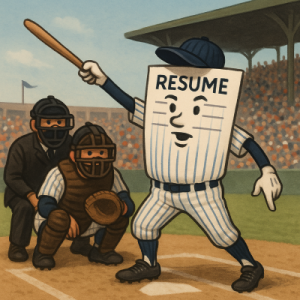

 If you’ve ever received feedback that a recruiter “couldn’t find what they needed” on your resume, it is tempting to assume the document lacked enough information. In most cases, the opposite is true. But the problem might not have been missing experience, perhaps it was just the resume organization and information architecture.
New clients get to hear that one from me alot. They insist every important accomplishment is already on the page (and they’re usually right). Yet recruiters continue to pass over resumes that contain exactly what they were hoping to find. The culprit is often how information is organized, prioritized, and presented to someone making dozens of hiring decisions under constant time pressure.
So, a resume isn’t consumed the way most people think.
It isn’t read from top to bottom on first contact. It is scanned, filtered, categorized, and mentally sorted before anyone even begins reading individual bullet points. Recruiters build a working hypothesis about a candidate in seconds, then look for evidence that either confirms or disproves that initial impression. If the supporting evidence is difficult to locate, well, they never get to the hypothesis part.
The conclusion “I couldn’t find what I needed” rarely means, “You didn’t do enough.” It usually means, “You made me work too hard.”
Recruiters don’t have the luxury of becoming detectives.
High-volume recruiting has always involved rapid decision-making, but today’s hiring environment amplifies that reality. SHRM reports that organizations continue to manage substantial recruiter workloads, with many recruiters handling roughly 20 requisitions at a time. At the same time, executive and professional hiring often stretches well beyond a month from opening to offer. Every additional application increases the need to process information efficiently.
That workload is going to affect their behavior, as you would expect.
When recruiters open a resume, they are unconsciously asking a series of questions.
What role does this person perform?
How senior are they?
Is their industry relevant?
Can I picture them doing the job I’m trying to fill?
See anything missing from that list?
No one starts by reading the 5th bullet under your second employer.
Before details ever matter to them, recruiters need orientation. They need enough context to decide whether investing another minute is worthwhile. Without that framework, even exceptional accomplishments lose value because they arrive before the reader knows where to place them.
I like to call it “framing the conversation” for your reader.
Think about walking into a grocery store where every product has been removed from its aisle and scattered randomly across the building. Nothing is missing. Every item is available. Shopping still becomes frustrating because there was no organization.
Many resumes sadly create the same experience.
Information has hierarchy, whether you design it or not.
One of the biggest misconceptions about resume writing is that every achievement deserves equal visual weight.
Well, it doesn’t, my friend.
Human attention naturally favors hierarchy. Our brains constantly rank incoming information according to relevance, prominence, and ease of recognition. Cognitive psychologists refer to this as selective attention. Faced with more information than we can consciously process, we instinctively search for meaningful patterns instead of evaluating every detail equally.
Recruiters behave no differently.
Suppose you’re applying for a Director of Operations position after spending 15 years leading manufacturing teams.
Which deserves greater visibility?
A Lean Six Sigma initiative that reduced production costs by 18%, or software proficiency you developed eight years ago?
Both belong somewhere on the resume. But only one belongs near the front of the conversation.
Strong resumes acknowledge this distinction. Weak resumes flatten everything into the same visual importance. Certifications receive identical emphasis as transformational business results. Administrative duties occupy the same amount of space as multimillion-dollar initiatives. The document technically contains the right information, but nothing tells the reader where to look first.
That, my people, is an information architecture problem, not a writing problem.
Your resume is directing attention whether you intend it to or not. Every heading, paragraph, bullet, and line break tells the reader what deserves attention first. When those things compete with one another instead of reinforcing each other, the reader begins hunting for answers instead of absorbing them.
Scanning follows predictable patterns.
Eye-tracking research conducted by the Nielsen Norman Group has consistently shown that people rarely read digital documents line by line during an initial review. Instead, they scan for headings, keywords, recognizable patterns, and visual anchors before committing to deeper reading.
Recruiters do exactly that.
They search for titles that match the position they are filling. They notice employer names they recognize. Their eyes stop on promotions, leadership scope, measurable business impact, technical expertise, industry terminology, and credentials. These elements become landmarks that help them navigate the document.
Now imagine those landmarks are buried.
Leadership experience appears halfway down a dense paragraph. Revenue responsibility is mentioned only once in the seventh bullet. Regulatory expertise sits beneath routine administrative tasks. Team size is omitted until page 2.
Nothing about the candidate changed. But you can be sure that the probability that the recruiter notices those qualifications did.
I have reviewed thousands of resumes over the years, and this issue appears with remarkable consistency. Clients often tell me, “Everything you’re recommending is already in there.” And they are often correct.
My response is usually the same: “I know. That’s not the issue.”
The issue is that their strongest qualifications are competing against information that carries far less hiring value. Context changes the meaning of everything that follows.
Imagine someone hands you a spreadsheet with hundreds of numbers but no column headings. The numbers are accurate. But they’re also almost meaningless to most people.
The moment someone adds labels, you can then spot trends, see relationships, and NOW you can make decisions, right?
Resumes work the same way.
Recruiters need context before accomplishments. If they don’t understand the scope of your position, the size of your employer, the complexity of your environment, or the significance of your role, they have no reliable way to judge whether your achievements represent routine performance or exceptional performance.
Consider two nearly identical statements.
Managed supplier quality program.
Directed supplier quality program supporting 320 global suppliers across North America, Europe, and Asia.
The 2nd statement doesn’t merely provide more detail. It changes how every accomplishment that follows will be interpreted. The reader now has a frame of reference.
That is why company descriptions, executive summaries, concise scope statements, and strategically placed metrics matter so much. They establish the lens through which the remainder of the resume will be viewed.
Without that lens, recruiters are forced to estimate significance on their own.
Most won’t.
Hiring decisions depend on reducing uncertainty. PERIOD. Anything that requires unnecessary interpretation slows the process and increases the likelihood that attention shifts to another candidate whose qualifications are immediately apparent.
The best resumes reduce cognitive effort and load.
Psychologists have long studied cognitive load, the amount of mental effort required to process information. The easier information is to organize and interpret, the more confidently people make decisions. Increase the effort required, and confidence declines even when the underlying information remains exactly the same. That principle applies directly to resume writing.
Every unnecessary obstacle consumes mental energy. Dense paragraphs. Inconsistent formatting. Generic section headings. Important accomplishments hidden beneath routine duties. Bullets that begin identically. Metrics scattered without explanation.
None of these issues disqualifies a candidate individually.
Collectively, they force the recruiter to assemble the story instead of simply understanding it.
The strongest resumes remove that burden. They anticipate the questions recruiters are already asking and answer them before those questions become obstacles. The document feels effortless to review because the organization does most of the work long before the recruiter reaches the final page. The best resumes will choreograph discovery.
LinkedIn’s workforce research continues to show that hiring is becoming increasingly skills-focused, even as employers seek candidates who can demonstrate business impact rather than simply list qualifications. At the same time, SHRM reports that nearly 7 in 10 organizations still struggle to recruit for many full-time positions, leaving recruiters to process large applicant pools under significant time pressure. In that environment, the resume that communicates fastest often earns the next conversation.
The most effective resumes don’t ask recruiters to search for evidence of qualification. They make those high-relevance qualification impossible to miss.