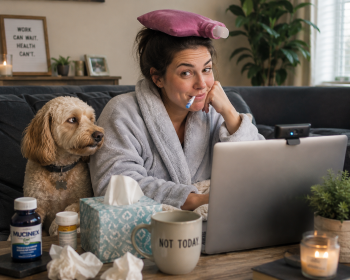
 Sick days are one of the most underused advantages in the modern workplace. Most professionals hesitate to take sick days, even when they know they need them, and that hesitation can being consequences in terms of performance and consistency.
We know what it is, it’s the pressure from management. Expectations around availability, responsiveness, and output have created an environment where stepping away becomes a risky proposition for many of us. Over time, that leads to fatigue and reduced effectiveness. And what follows is preventable burnout.
If you want to stay competitive over the long term, you need to rethink how you approach sick days.
The system benefits when you avoid them.
There is an incentive structure at play here When employees do not take sick days, work continues uninterrupted. Yeah, we get our deadlines met and generate the all-mighty output, but that does not mean it is sustainable, right?
Data from the U.S. Travel Association shows that a significant portion of workers leave paid time off unused each year. While much of that data centers on vacation, the same behavior applies to sick days. Folks hold back from taking time off, often out of concern for how it will be perceived.
But hey, sick days are part of your compensation. When you avoid using them, you are giving up something you have already earned. Professionals who understand this treat sick days as a resource. They use them when needed rather than waiting for a breaking point.
Working through fatigue lowers your output.
There is still a belief that pushing through exhaustion demonstrates commitment. In practice, it often leads to lower-quality work. When fatigue sets in, focus becomes inconsistent and here come the errors. Tasks that would normally take an hour now take three and the work quality is lower.
The American Institute of Stress has reported that workplace stress contributes to reduced productivity and higher error rates. Yep, a predictable result of sustained pressure without recovery.
Sick days can help break that pattern. They give you space to reset before your performance drops in a way that can show up on that performance review later. Professionals who maintain strong output over time understand when to step away.
Burnout can kind of sneak up on you. Things are manageable at first. You pushed her a busy week. Then another. But are you noticing the energy level dropping what did diminished motivation? Usually not until you screw up that report or miss that deadline.
The World Health Organization classifies burnout as an occupational phenomenon tied to unmanaged stress. Sick days help us prevent that from happening. Taking time off earlier allows for faster recovery and a quicker return to full capacity. If we wait until we are obviously exhausted, it is going to take us longer to recover, right?
Workplace culture still matters.
Policy and practice are not always in sync. Some organizations actively encourage employees to take time off when needed. But others operate with an expectation of constant availability, even if it is not written anywhere. Understanding (and accounting for) how your environment operates helps.
Watch how your manager responds when someone takes time off. Notice whether colleagues disconnect fully or remain partially engaged. This can reveal what is actually accepted within your team.
Sick days should be used, but they should be used with awareness. Lining up your approach with your environment reduces unnecessary friction.
Communication affects perception
Sometimes, it isn’t the taking of the sick days that damages your reputation, it is the poor communication that does. When you step away without any context, your team is left to manage the uncertainty, which can lead to frustration or incorrect assumptions about your availability.
A clear message can solve most of that.
Confirm your absence. Be sure to identify anything urgent and set expectations for your return. Yeah, we might need that break, but we have to maintain that trust with everyone still there. You don’t necessarily need to provide personal details. But you do need to provide enough information for your team to operate effectively.
Strong communication keeps your absence from becoming a problem.
Timing still plays a role. Not all sick days are viewed the same way. Absences during critical deadlines or high-visibility projects tend to draw more negative attention. That does not mean you should avoid taking time off when you are unwell, but it does mean timing matters when you have the ability to plan.
If you notice fatigue coming on, step away before major deadlines rather than during them. If illness is unexpected, focus on clear handoffs and communication. Sick days used with awareness of timing are less likely to create disruption and keep everybody on mission.
Remote work has blurred the boundaries
Remote and hybrid work environments have changed how professionals think about time off. Just because you are working at home does not mean that sometimes you don’t need to step away from the screen for a while. The assumption is sometimes that if you are at home, even if “off” you can still contribute at some level. But sometimes, we just really “don’t need to think about work at all.”
But be careful and ensure that you are not using low effort work days in the place of taking those sick days. Trust me, stepping away is going to be a better choice than putting bad game on tape.
When it is all said and done, those sick days are yours. It is part of your compensation package. Not using that sick time and having it go away at the end of the year is basically the equivalent of leaving money (and good mental health) on the table. And we don’t do that.