

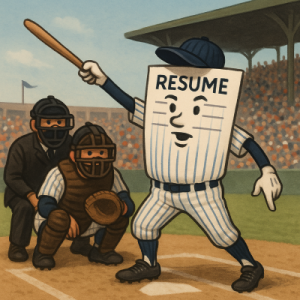
 Every October, millions tune in to watch the World Series—the ultimate test of preparation, timing, and teamwork. In many ways, resume writing demands the same mindset. Success depends on how well you plan, adapt, and deliver when the pressure is on. At its core, high-performance resume strategy is relationship building between your story and the reader’s priorities. The better that relationship, the better your odds of winning the career championship job you are after.
Think about what happens before the first pitch. Teams spend months studying matchups, reviewing data, and practicing fundamentals. A high-performance resume requires the same discipline. Relationship building begins long before you submit an application. It starts when you define your target audience, study what they value, and decide which accomplishments prove you can deliver. The professionals who treat this as preseason work (the research, the alignment, the editing) enter the job market ready to hit cleanly from the first swing.
Once the game begins, every pitch matters. So does every word on your resume. Recruiters skim for 6 to 8 seconds before deciding whether to keep reading, according to research from Ladders Inc. That moment is your first at-bat. Clear phrasing, strong verbs, and measurable results are the contact points that send your story into play. Extra sentences, weak openings, or vague language are foul balls that waste opportunity.
The best hitters don’t chase every pitch. They wait for the one they can drive. The same principle applies to resume content. Your resume’s improves when you select only the achievements that fit your audience’s strike zone. Too many applicants crowd their resumes with everything they have ever done. That’s batting practice, not game-winning strategy. Choose details that speak directly to the challenges of the job you want now.
Behind every championship team is chemistry. Players trust each other to cover the field and execute under pressure. High-performance resume writing benefits from its own version of teamwork: mentors who review drafts, professional writers who refine structure, or colleagues who provide honest feedback. Inviting perspective shows humility and commitment to growth—qualities that strengthen relationship building with any future employer.
Coaches rely on data to adjust strategy mid-series. They track batting averages, fielding percentages, and pitch counts. You can apply the same analytical lens to your resume. Monitor which version of your document earns callbacks. Test different openings or formatting. If one version gets more traction, study why. That evidence tells you how well your relationship building is landing with decision-makers.
There’s also the mental side of performance. Every player faces slumps. Professionals experience the same when job searches stretch longer than expected. Instead of rewriting the entire resume in frustration, return to fundamentals. Ask: does this document clearly connect my achievements to the employer’s needs? Relationship building in a resume is about empathy—seeing the game from the hiring manager’s dugout.
Consider this example. A mid-level operations leader I worked with trimmed a 4-page resume down to 2 by cutting minor projects and tightening language. Within a month, his interview rate doubled. Nothing about his career changed; only the clarity of his message did. By focusing on concise storytelling and relevant metrics, he built trust faster, proof that precision wins more often than volume.
Consistency is what separates teams that make the playoffs from those that don’t. The same rule applies here. Keep your resume updated even when you’re not job hunting. Add new wins while they’re fresh, and archive old material before it clutters the lineup. Relationship building thrives on consistency because credibility grows through steady refinement, not frantic rewriting under deadline.
A long baseball season is a grind. Every game tests endurance. The job market can feel that way too. Yet professionals who prepare intentionally and edit ruthlessly enter interviews with confidence. They know their resume tells a story worth hearing, one crafted through discipline, reflection, and a genuine understanding of what the reader values.
A World Series win doesn’t happen by accident. Neither does a call from a top recruiter. Both are earned through clarity, teamwork, and focus. Approach your resume the way a champion hitter approaches the plate: study the signals, trust your swing, and make every connection count. That’s how relationship building turns opportunity into victory.