
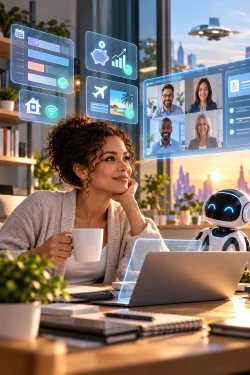
 Picture yourself waking up on a Tuesday morning while working in 2040. Your personal AI assistant has already reviewed your schedule, rearranged 2 meetings, negotiated a better insurance rate, and informed your employer that you will be working from home.
You never requested that last part, but apparently your assistant noticed you slept poorly and decided commuting would be bad for your productivity.
Meanwhile, your employer’s AI has been communicating with yours since 5:30 a.m. They’ve settled a scheduling dispute, approved your vacation, and discussed your performance.
You have yet to brush your teeth.
Welcome to the workplace of 2040. (Or at least one plausible version of it.)
Predicting employment 14 years into the future is risky business. Current technological developments offer some interesting clues about what might be coming. So I’m gonna try (bear with me).
Your New Coworker Doesn’t Need Health Insurance
By 2040, many professionals may supervise artificial intelligence rather than simply use it.
Microsoft’s 2025 Work Trend Index found that (hold on to your knickers) 81% of surveyed business leaders expected AI agents to become substantially integrated into their organizations’ AI strategies within 12 to 18 months.
Unlike conventional chatbots, AI agents can perform multiple connected tasks with limited human intervention.
Imagine an accounting manager supervising 3 employees and 15 AI agents handling reconciliations, financial reports, and transaction monitoring. The manager spends less time preparing spreadsheets and more time evaluating decisions.
Of course, Tuesday afternoon might involve figuring out why Agent Number 7 classified the company’s office furniture as livestock.
Technology has a remarkable ability to create new problems while solving old ones.
Your Workweek Could Get Shorter. Eh, Maybe.
If automation allows employees to accomplish 40 hours of work in 20, perhaps the traditional workweek will finally shrink. Imagine finishing your responsibilities Thursday afternoon and enjoying a 3-day weekend.
There is, unfortunately, another possibility: employers might simply double their expectations of you.
A marketing professional managing 4 campaigns today could be expected to oversee 25 by 2040.
Whether employees enjoy shorter schedules or heavier workloads will depend on how organizations distribute productivity gains.
Technology alone cannot give us Friday off. Somebody still has to approve it.
The Office Might Follow You Everywhere
Today’s laptop could look positively prehistoric by 2040.
Augmented reality glasses might project virtual computer screens into your surroundings. You could review financial reports while sitting in your backyard. Virtual meetings might feature realistic three-dimensional representations of colleagues sitting around your dining room table.
You could even attend in pajamas, provided the technology convincingly displays a business suit. Autonomous vehicles might turn commuting into productive or relaxing personal time.
Naturally, millions of workers will still need to be physically present. Nurses, mechanics, construction workers, and restaurant employees cannot necessarily perform their jobs through holograms.
And someone will undoubtedly continue scheduling meetings that could have been emails. (This will continue to grind my wife’s gears)
Job Interviews Could Become Pretty Strange
By 2040, traditional resumes might be supplemented by continuously updated digital career profiles containing verified credentials, accomplishments, and work samples. Your personal AI could identify opportunities and negotiate preliminary employment terms with an employer’s recruiting system.
Imagine your AI negotiating a salary increase while you’re shopping for groceries.
Employers might increasingly use realistic work simulations to evaluate candidates.
An operations executive could manage a simulated supply chain emergency. A customer service applicant might confront an exceptionally difficult virtual customer.
(That last exercise should probably include hazard pay.)
Of course, employers would still need to verify qualifications and ensure automated assessments are fair.
The Jobs Nobody Has Invented Yet
The World Economic Forum’s Future of Jobs Report 2025 projected that labor market changes could create 170 million jobs and displace 92 million by 2030.
Those projections certainly do not guarantee what happens by 2040, but they illustrate how technology can eliminate some occupations while creating others.
We might see AI behavior auditors, digital identity specialists, robotic healthcare coordinators, and professionals specializing in human-machine collaboration.
And when household robots become commonplace, someone will make a fortune repairing them after they attempt to vacuum the family cat.
Your Personal Assistant Might Know Too Much
Imagine an assistant that understands your finances, health preferences, professional responsibilities, and household schedule. It could arrange appointments, recommend training, and identify attractive career opportunities.
Convenient? Absolutely.
But imagine your employer using similar technology to monitor your attention, emotional state, or enthusiasm during meetings.
The workplace of 2040 could introduce serious questions about privacy, surveillance, and automated management. We may eventually need legislation protecting our right to have a bad Monday without a computer documenting it.
Nobody Gets to Stop Learning
The World Economic Forum’s 2025 research estimated that nearly 40% of workplace skills could change by 2030. If that trend continues, workers may need to update their qualifications much more frequently.
Personalized AI tutors and immersive simulations could make professional training more accessible. A warehouse supervisor might learn robotic fleet management. An administrative professional could develop expertise in automated workflows. And yes, there will probably still be mandatory training videos explaining how to recognize suspicious emails.
Some traditions are apparently immortal.
Will Working in 2040 Actually Be Better?
Possibly. Automation could reduce dangerous tasks, improve accessibility, eliminate tedious administrative work, and give small businesses capabilities once reserved for major corporations.
But those benefits will not necessarily reach everyone equally. Some employees may enjoy extraordinary flexibility while others face displacement, surveillance, or more demanding workloads.
Ultimately, employment in 2040 will still involve familiar concerns: reasonable compensation, meaningful work, competent management, and enough time to enjoy life outside the office.
And somewhere, a frustrated employee will be arguing with an AI assistant that just scheduled mandatory team-building exercises for 7:00 on Saturday morning.
Some things never change.